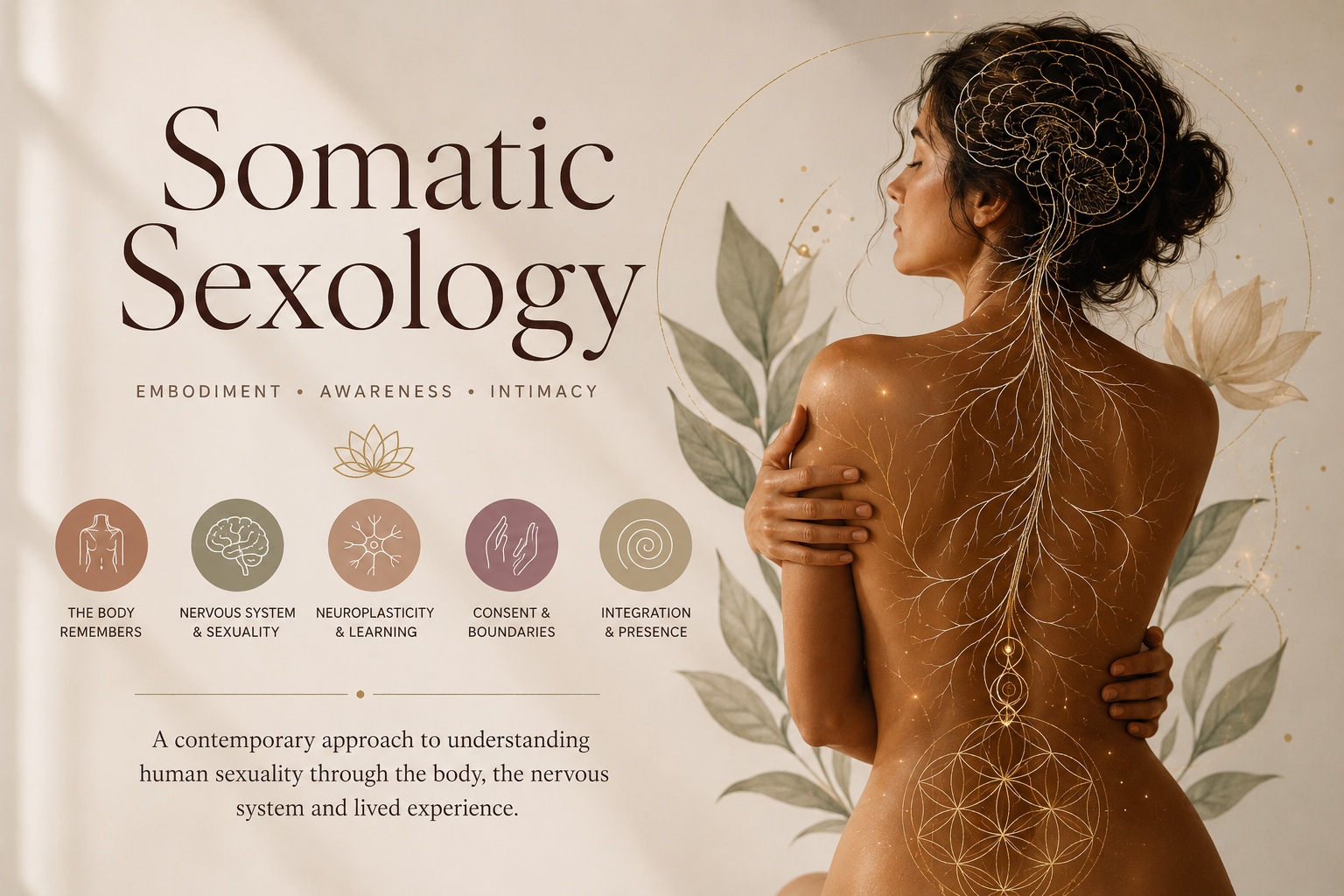

Every experience of intimacy, desire, pleasure and connection is lived through the body. Although sexuality is often understood through the lenses of behaviour, psychology or physiology, our lived experience extends far beyond these perspectives. The way we breathe, perceive sensation, respond to touch and experience safety all influence how sexuality is expressed, experienced and understood.This …
Every experience of intimacy, desire, pleasure and connection is lived through the body. Although sexuality is often understood through the lenses of behaviour, psychology or physiology, our lived experience extends far beyond these perspectives. The way we breathe, perceive sensation, respond to touch and experience safety all influence how sexuality is expressed, experienced and understood.
This understanding lies at the heart of Somatic Sexology, an interdisciplinary field that integrates contemporary sexology with embodiment, neuroscience and experiential learning. Rather than focusing solely on sexual function or behaviour, it explores how the body, the nervous system and lived experience shape our relationship with intimacy, pleasure, desire and human connection.
Throughout this article, we will explore the foundations of Somatic Sexology, the principles that guide this contemporary discipline, and how I integrate its insights into my work while maintaining a clear distinction between Somatic Sexology and the philosophical tradition of Classical Tantra.
What Is Somatic Sexology?
Somatic Sexology is a contemporary approach to sexuality that recognises the body as an essential part of human sexual experience. While traditional sexology has significantly expanded our understanding of sexual health, anatomy, physiology and behaviour, Somatic Sexology explores another dimension: how sexuality is lived through the body.
The word somatic comes from the Greek soma, meaning the living body. Rather than viewing the body as a biological structure alone, Somatic Sexology understands it as the place where sexuality is experienced through sensation, movement, breath, emotion and embodied awareness. It recognises that our relationship with intimacy is shaped not only by what we think, but also by how we experience ourselves from within.
This perspective draws upon contemporary research in sexology, embodiment and neuroscience to better understand the relationship between the body, the nervous system and human sexuality. Topics such as embodied awareness, consent, neuroplasticity and nervous system regulation all contribute to a more integrated understanding of intimacy and sexual wellbeing.
Rather than asking only how sexuality functions, Somatic Sexology also asks how sexuality is experienced. In doing so, it invites a deeper exploration of the body—not as something to fix or control, but as an essential source of awareness, learning and connection.
Embodiment: The Body as Lived Experience
At the heart of Somatic Sexology lies the concept of embodiment. While the word is often translated simply as “being in the body,” its meaning is far richer. Embodiment refers to the lived experience of inhabiting ourselves from within—to perceiving the body not as an object to observe or control, but as the place where life is continuously experienced.
In everyday life, many people spend far more time thinking about their bodies than actually feeling them. We analyse, judge and evaluate our appearance, our performance and our responses, yet often remain disconnected from the subtle sensations that shape our experience. Breathing, tension, posture, movement, emotional responses and internal sensations frequently unfold outside conscious awareness, even though they influence how we relate to intimacy, pleasure and connection.
Somatic Sexology invites a different relationship with the body. Rather than approaching it as something to fix or optimise, it encourages a deeper capacity to notice, feel and understand our embodied experience. Sensations become information rather than obstacles. The body becomes a source of awareness rather than something that must simply be managed or controlled.
From this perspective, embodiment is not a technique but a way of relating to ourselves. It allows us to recognise how thoughts, emotions, physiological responses and the nervous system continually interact, creating the unique way each person experiences sexuality. As awareness develops, the body gradually becomes not only the place where sexuality is expressed, but also one of our greatest sources of learning, self-understanding and authentic connection.
The Nervous System and Sexuality
The nervous system plays a central role in the way we experience sexuality. Desire, arousal, pleasure, intimacy and connection are not determined solely by anatomy or hormones; they are also influenced by how the body perceives and responds to the world around it. Every intimate experience is shaped by an ongoing interaction between the brain, the body and the nervous system.
One of the nervous system’s primary functions is to continuously assess whether an environment feels safe or threatening. These assessments often occur outside conscious awareness, influencing muscle tone, breathing, heart rate, emotional responses and our capacity to remain open to intimacy. When the body perceives safety, it is generally easier to experience relaxation, curiosity, connection and pleasure. Under conditions of stress or perceived threat, the body may instead shift towards protection, reducing its capacity to receive, explore or remain present.
Somatic Sexology recognises that these physiological responses are not signs of success or failure, but natural adaptations that help us navigate life. Understanding how the nervous system influences sexual experience allows us to approach ourselves with greater compassion rather than judgement. Instead of asking “What’s wrong with me?”, we begin asking “What might my body be communicating?”
From this perspective, developing awareness of the nervous system is not about controlling every response but about cultivating a greater capacity to recognise our internal state. As this awareness grows, many people discover that sexuality becomes less about performance and more about presence, creating space for more authentic, responsive and connected experiences.
Neuroplasticity and Sexual Learning
One of the most significant discoveries in modern neuroscience is that the brain and nervous system remain capable of change throughout life. This ability, known as neuroplasticity, allows us to develop new neural pathways through learning, experience and repeated practice. Rather than being permanently fixed, many of our patterns of perception, behaviour and emotional response can gradually evolve over time.
When applied to sexuality, this understanding offers an encouraging perspective. Our relationship with intimacy, pleasure and connection is shaped not only by biology, but also by our life experiences, relationships, cultural influences and the ways our nervous system has learned to respond. While some of these patterns may feel deeply ingrained, they are not necessarily permanent.
Somatic Sexology recognises that learning is not limited to the mind. Every new experience of safety, awareness, communication or embodied presence has the potential to support new ways of relating to ourselves and others. This does not mean that change is immediate or guaranteed, but it reminds us that sexuality can continue to develop throughout life.
Rather than trying to force transformation, Somatic Sexology encourages gradual learning through awareness and embodied experience. From this perspective, growth is not about becoming someone different, but about expanding our capacity to experience intimacy, pleasure and connection with greater presence, choice and authenticity.
Consent and Healthy Boundaries
Consent is one of the fundamental principles of Somatic Sexology, yet it extends far beyond simply saying “yes” or “no.” At its core, consent is an ongoing process of awareness, communication and choice. It begins with the ability to recognise our own internal experience before expressing it to another person.
Healthy boundaries play an equally important role. They allow us to recognise what feels comfortable, what does not and when those feelings may change. Rather than being fixed, boundaries are dynamic and can evolve from one moment to the next. Learning to notice and communicate them is an essential part of developing healthier and more authentic relationships.
From a somatic perspective, consent is not understood only as a verbal agreement but also as an embodied experience. Paying attention to bodily sensations, emotional responses and internal signals helps us recognise what genuinely feels aligned with our needs and values. This embodied awareness often leads to greater self-trust, clearer communication and more conscious choices.
Ultimately, Somatic Sexology recognises that healthy sexuality is built not only on knowledge or technique, but also on mutual respect, presence and the freedom for each person to make informed choices about their own body and their intimate experiences.
My Approach to Somatic Sexology
My approach to Somatic Sexology is rooted in the understanding that sexuality is an embodied experience. While thoughts, emotions and beliefs certainly influence the way we relate to intimacy, every experience of desire, pleasure and connection is ultimately lived through the body. This perspective has enriched my work by offering a contemporary understanding of how embodiment, the nervous system and lived experience shape human sexuality.
At the same time, I believe it is essential to distinguish Somatic Sexology from Classical Tantra. Although both value direct experience and the importance of the body, they arise from different traditions and explore different questions. Somatic Sexology is grounded in contemporary research and education, while Classical Tantra is a philosophical and spiritual tradition centred on consciousness and non-duality.
Rather than blending these disciplines into a single method, I allow each to contribute its own perspective. Somatic Sexology helps me understand how sexuality is experienced through the body, while Tantra provides the philosophical foundation through which I understand awareness, embodiment and human experience. Together, they complement one another without losing their individual integrity.
For me, integrating these perspectives is not about combining ancient wisdom with modern science for the sake of innovation. It is about respecting the unique contribution of each, creating an approach that is both intellectually honest and deeply embodied, while remaining clear about where philosophy ends and contemporary science begins.
When combined, somatic sexology and Tantra offer a holistic approach to sexual and reproductive health, empowering individuals to reclaim their bodies, heal from trauma, and cultivate a deeper connection to their sexuality and creative life force. This integrative practice can be profoundly transformative, addressing challenges such as sexual dysfunction, low self-esteem, stress, lack of sexual education, or trauma related to childbirth, sexual abuse, or other life experiences. It also provides a nurturing space for relaxation and self-discovery.
Self-knowledge is a continuous journey of understanding and connecting with ourselves. As we explore deeper layers of our being, we unlock new pathways to our source of inspiration and vitality, enriching not only our personal growth but also the way we relate to the world around us.
Hi, I'm May Gonzalez.
I’m a Sacred Sexuality Educator, Somatic Sexologist and Tantra Teacher, exploring the meeting point between body, sexuality, energy and consciousness. My work brings together embodied practices, Tantra and sexual wellbeing to support a deeper relationship with pleasure, intimacy and the body.
More About Me →Instagram Journey
Ritual, embodiment, sacred sexuality and glimpses from my work and journey.