Enhance your healing journey by integrating Reiki with chakra balancing. Discover how these practices work together for improved health and inner harmony.
Few spiritual traditions have generated as much fascination—and as much misunderstanding—as Tantra. For many people, the word immediately evokes images of sexuality, erotic massage or intimate rituals. Others associate it with esoteric practices, secret teachings or mystical experiences. These popular interpretations have become so widespread that they often overshadow the philosophical depth and historical complexity of the tradition itself.
In contemporary culture, Tantra is frequently presented as a method for improving relationships or expanding sexual pleasure. While some modern approaches explore these themes in meaningful ways, reducing Tantra to sexuality alone obscures the richness of a tradition that has influenced Indian philosophy, religion, yoga, meditation and contemplative practice for more than a millennium.
To understand Tantra, it is first necessary to set aside many of the assumptions that surround the word today. Tantra did not emerge as a manual of sexual techniques, nor was it conceived as an alternative therapy or a lifestyle movement. It developed as a sophisticated spiritual and philosophical tradition that sought to answer some of the most fundamental questions of human existence: What is consciousness? What is the nature of reality? How can human beings recognise their deepest nature while fully participating in the world?
These questions continue to resonate because they address a universal human experience. Every culture has explored the relationship between body and spirit, matter and consciousness, individuality and the greater mystery of existence. Tantra offers one of the most distinctive responses to these questions by proposing that awakening is not achieved through withdrawal from life but through a more profound participation in it.
Unlike traditions that emphasise renunciation or the rejection of worldly experience, Tantra embraces the ordinary as a potential expression of the sacred. The body is not viewed as an obstacle to spiritual life, but as one of its primary gateways. Breath, sensation, relationship, movement and awareness all become opportunities for recognising a deeper dimension of reality. In this sense, Tantra is less concerned with escaping human experience than with transforming the way it is perceived.
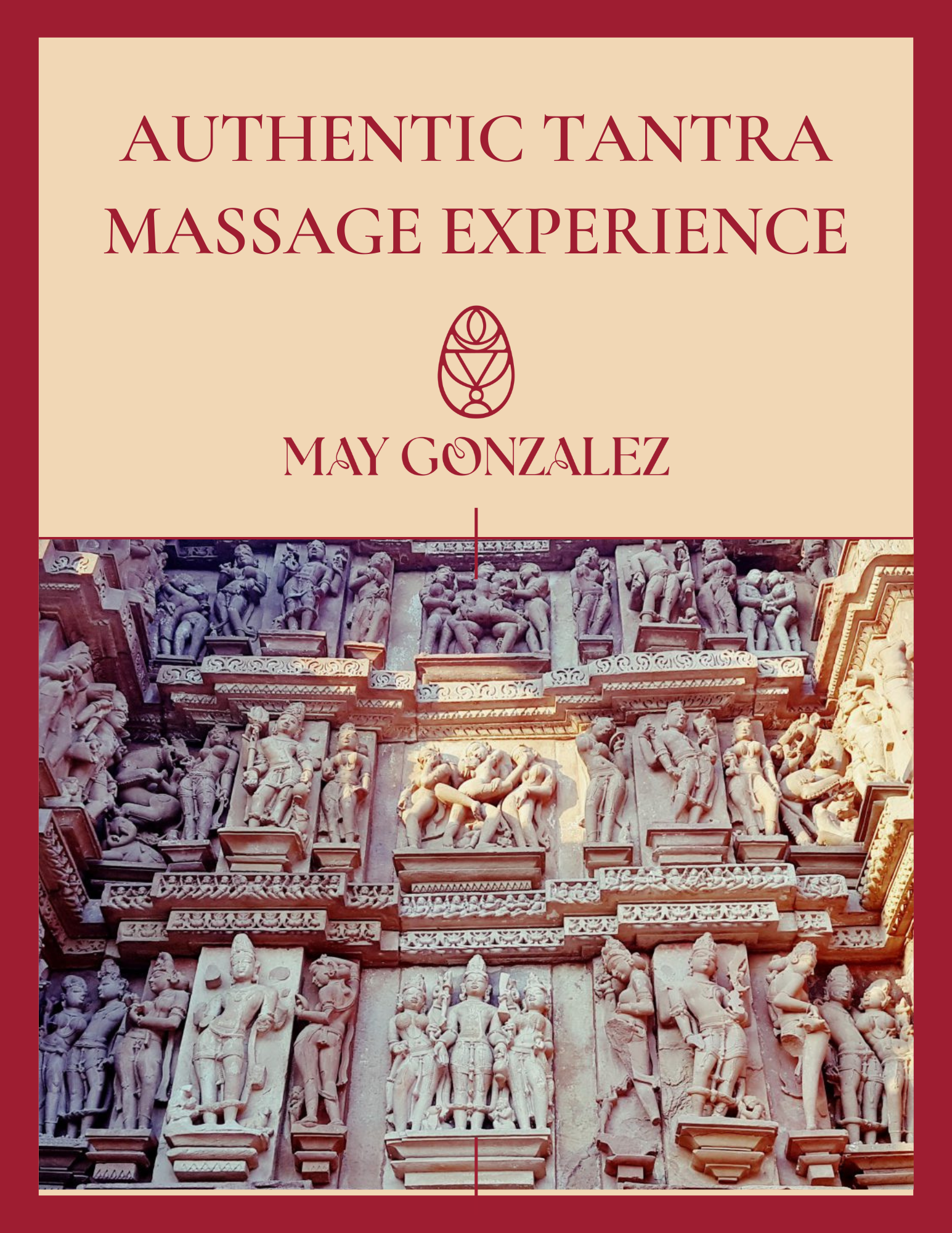
The purpose of this article is not to provide an exhaustive historical study or a technical manual of Tantric practices. Instead, it offers an accessible introduction to the philosophical foundations of Classical Tantra, exploring its origins, its central principles and its enduring relevance. It also explains the perspective from which I use the expression Authentic Tantra throughout my work—a term that reflects not a separate tradition, but a commitment to approaching Tantra with respect for its philosophical roots while integrating contemporary understanding of embodiment and human sexuality.
Before discussing practices, symbols or modern interpretations, it is important to begin with a more fundamental question: What does the word Tantra actually mean?
What Makes Tantra Authentic?
Authenticity is not determined by how ancient a ritual appears, how many Sanskrit words are spoken or how closely historical forms are reproduced. It is revealed through the depth of awareness, integrity and presence that underlie every practice.
This understanding forms the foundation of everything I describe as Authentic Tantra: an approach rooted in the philosophical vision of Classical Tantra while remaining open to contemporary knowledge of embodiment, human sexuality and the lived experience of being human.
What Does the Word Tantra Mean?
Few Sanskrit words have been translated in as many different ways as Tantra. Depending on the context, it has been interpreted as “to weave,” “to extend,” “to expand,” or even “a framework” or “system.” None of these translations is entirely sufficient on its own, yet each reveals an aspect of how the tradition understands reality.
The image of weaving is particularly illuminating. A woven fabric is created from countless individual threads that only acquire meaning through their relationship with one another. Remove a single thread and the whole pattern is subtly altered. Likewise, Tantra proposes that existence cannot be understood by separating body from mind, spirit from matter or the individual from the universe. Reality is not composed of isolated parts but of interconnected processes that continuously influence one another.
For this reason, Tantra is better understood as a worldview than as a collection of techniques. Meditation, ritual, mantra, visualisation and yogic practices certainly form part of the tradition, but they are expressions of a much broader philosophical vision. Without understanding that vision, individual practices lose much of their original meaning.
Another important aspect of the word Tantra is that it historically referred not only to a philosophical current but also to a body of sacred texts. These scriptures, composed over several centuries, contained teachings on ritual, cosmology, meditation, theology, ethics and spiritual practice. They were transmitted within specific lineages and often required oral instruction from a teacher to be properly understood. As a result, the term gradually came to describe both the teachings themselves and the traditions that preserved them.
This historical context is important because it reminds us that Tantra was never a single book, a single philosophy or a single religion. From its earliest development, it existed as a constellation of traditions that shared certain foundational principles while expressing them in diverse ways.
Although the practices varied, one underlying insight remained remarkably consistent: human beings already participate in the sacred nature of reality, even if they do not yet recognise it. Spiritual practice therefore is not primarily about becoming something different. It is about transforming perception so that what has always been present can be recognised more clearly.
This emphasis on recognition rather than acquisition distinguishes Tantra from approaches that present enlightenment as something external to ordinary life. Instead of searching for truth elsewhere, Tantra encourages practitioners to discover it within the texture of their own experience—through breath, awareness, relationship, embodiment and contemplative inquiry.
Understanding this shift is essential because it influences every other aspect of Tantric philosophy. Before exploring its practices, one must first understand the worldview from which those practices emerged.
The Historical Emergence of Tantra
Tracing the origins of Tantra is not a straightforward task. Unlike many philosophical schools that can be associated with a single founder or a clearly defined historical moment, Tantra developed gradually over several centuries through a wide range of religious and cultural movements across the Indian subcontinent.
Most scholars place the emergence of recognisably Tantric traditions between the fifth and twelfth centuries CE, although many of the ideas that later became characteristic of Tantra have much older roots. Rather than appearing suddenly, Tantra evolved through a dynamic process of dialogue between existing religious traditions, local ritual practices and philosophical inquiry. It drew upon elements of Vedic religion, early forms of Yoga, devotional movements, ascetic traditions and regional goddess cults, gradually weaving these influences into new systems of thought and practice.
One of the reasons Tantra can seem difficult to define is that it was never a unified movement. There was no single Tantric school, no universal doctrine and no central authority overseeing its development. Instead, numerous lineages emerged across different regions of India, each preserving its own scriptures, rituals and methods while sharing certain philosophical assumptions. Some traditions developed within Shaivism, centring their teachings on Shiva as the supreme principle of consciousness. Others flourished within Shakta traditions, emphasising the dynamic power of the Divine Feminine. Buddhist communities also developed their own Tantric systems, particularly within Vajrayana, adapting many Tantric methods to Buddhist philosophical frameworks.
Despite their diversity, these traditions shared an important departure from many earlier religious models. Instead of viewing liberation primarily as an escape from the material world, they proposed that the world itself could become the very field of awakening. Reality was no longer understood as something to be abandoned but as something to be recognised in its deepest nature.
This represented a profound transformation in spiritual thought. Earlier ascetic traditions often regarded desire, the senses and the body as obstacles that bound human beings to suffering. Tantra did not deny the challenges of attachment or ignorance, but it questioned the assumption that the material world was inherently separate from the sacred. If consciousness permeates all existence, then every aspect of experience has the potential to reveal that same consciousness when approached with sufficient awareness.
It is important, however, not to romanticise this historical development. Tantric traditions were highly sophisticated systems requiring years of study, disciplined practice and, in many cases, formal initiation within a lineage. They combined philosophy with ritual, meditation with theology, devotion with contemplative inquiry. Far from encouraging spiritual improvisation, they developed detailed methods intended to transform perception through sustained practice and ethical responsibility.
For this reason, Classical Tantra is best understood not as a collection of exotic techniques but as one of the most intellectually and spiritually sophisticated developments in the history of Indian philosophy. Its influence would eventually extend far beyond its original communities, shaping later forms of yoga, devotional practice, sacred art, temple architecture and contemplative traditions that continue to inspire practitioners around the world today.
The Philosophical Foundations of Classical Tantra
Although Tantra developed through diverse schools and lineages, its various expressions are united by a philosophical vision that profoundly reshapes the way reality is understood. At its heart lies the conviction that consciousness is not an isolated phenomenon confined to the human mind, but the very ground of existence itself. Everything that exists—matter, energy, thought, emotion, nature and life—is understood as arising within and expressing the same universal consciousness.
This perspective transforms the purpose of spiritual practice. Rather than attempting to escape the world in search of a higher reality, Tantra invites practitioners to recognise that reality has never been absent. The challenge is not that the sacred is hidden, but that human perception is often obscured by habitual patterns of identification, fear, attachment and unconscious conditioning.
From this perspective, spiritual awakening is fundamentally a transformation of perception. The world does not need to become sacred; it is already sacred. What changes is our capacity to recognise it.
This seemingly simple insight has profound implications. It shifts spirituality away from acquiring extraordinary experiences and towards cultivating a more refined quality of awareness. The emphasis moves from changing external circumstances to changing the way consciousness relates to experience itself.
The Principle of Non-Duality
Among the defining characteristics of Classical Tantra is its non-dual understanding of reality. The term “non-dual” is often misunderstood as suggesting that differences disappear or that individuality becomes meaningless. In fact, non-duality proposes something far more subtle.
Human perception naturally divides experience into opposites. We distinguish body from mind, sacred from ordinary, pleasure from pain, self from other, spirit from matter. These distinctions are useful for navigating everyday life, yet Tantra suggests that they do not reveal the deepest nature of reality.
Beneath the diversity of forms lies a single field of consciousness expressing itself in infinitely different ways. Diversity is therefore not denied but embraced. Mountains, rivers, thoughts, emotions, human beings and stars are not identical, yet all participate in the same underlying reality.
This understanding profoundly influences the Tantric approach to spirituality. If consciousness permeates every aspect of existence, then no part of life is inherently separate from the path of awakening. Daily life ceases to be something that distracts us from spirituality. Instead, it becomes the very place where spiritual understanding is cultivated.
Non-duality also transforms the relationship we have with ourselves. Instead of constantly struggling to reject certain aspects of our experience while clinging to others, Tantra encourages a deeper intimacy with the totality of human existence. Thoughts, emotions and sensations are no longer viewed merely as obstacles to overcome, but as phenomena that can be observed with increasing clarity and awareness.
This does not imply passive acceptance of every impulse or behaviour. Rather, it reflects the understanding that genuine transformation arises through awareness rather than suppression. What is clearly seen can gradually be understood, integrated and transformed.
Shiva and Shakti: Consciousness and Creative Power
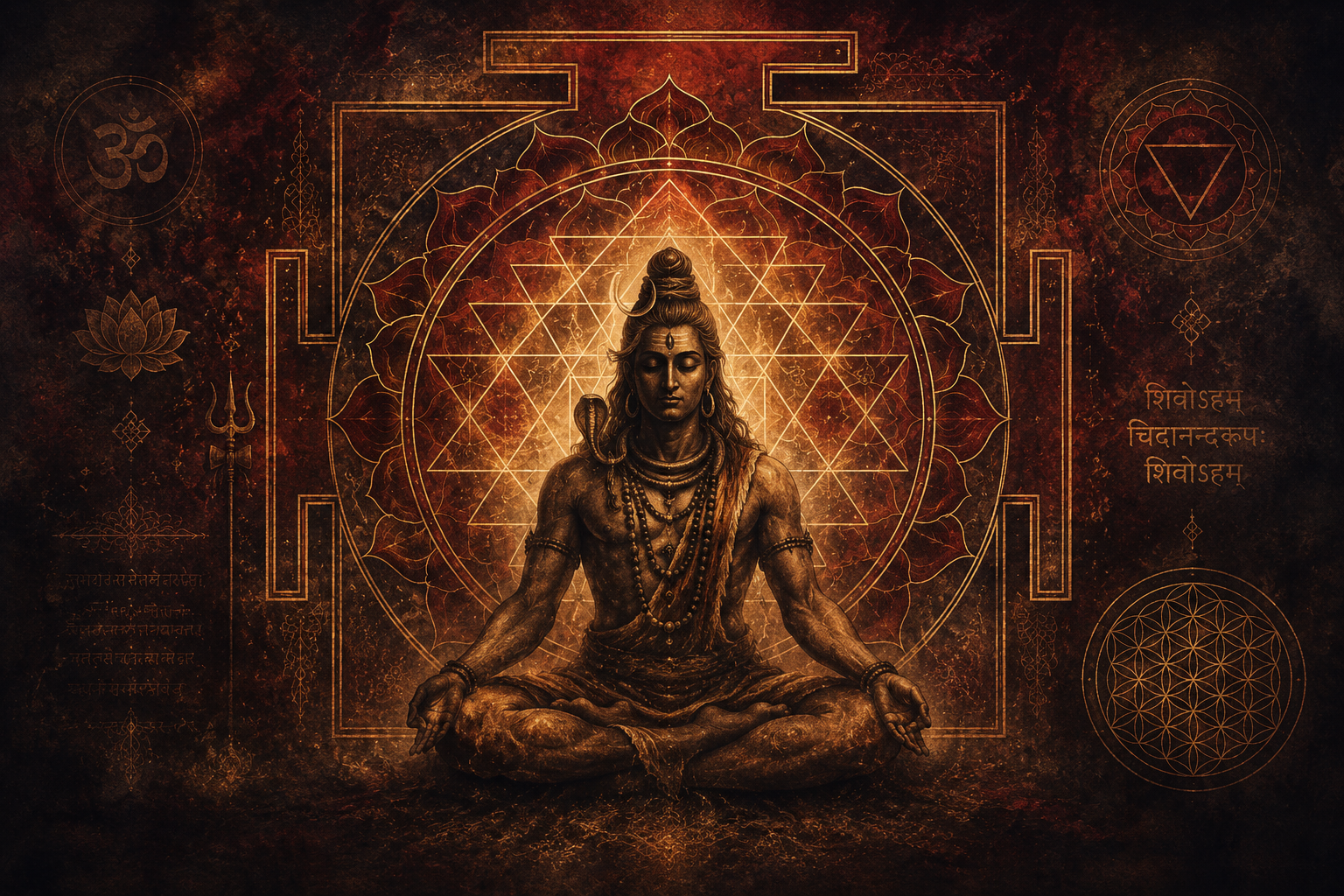
Among the most recognisable symbols within Tantra are Shiva and Shakti. Popular culture often presents them simply as divine figures from Hindu mythology, but within Tantric philosophy they function primarily as symbolic expressions of universal principles that operate throughout existence.
Shiva represents pure consciousness. He symbolises the silent, witnessing awareness that remains constant beneath the ever-changing flow of experience. Shiva does not act, create or transform. Instead, he represents the limitless space within which all experience unfolds.
Shakti represents the dynamic aspect of reality. She is movement, creativity, intelligence, vitality and transformation. Every thought, every emotion, every breath, every natural process and every manifestation of life can be understood as expressions of Shakti.
These two principles should never be interpreted as opposing forces. They are not separate entities struggling for balance. Instead, they exist in perpetual unity. Consciousness without creative power remains unexpressed, while creative power without consciousness lacks awareness of itself. Together they form an indivisible whole.
For this reason, Tantra frequently describes existence as the eternal dance of Shiva and Shakti. The image of dance is particularly meaningful because it suggests relationship rather than separation. Awareness and energy continually reveal one another. Stillness gives rise to movement, while movement continuously reveals the presence of stillness.
This symbolism also carries profound psychological significance. Every human being embodies both dimensions. We possess the capacity to witness our experience with clarity while simultaneously participating fully in the dynamic flow of life. Spiritual maturity therefore does not require choosing contemplation over action or silence over creativity. Instead, it invites an integration in which awareness and participation support one another.
Consciousness and the Nature of the Self
One of the central questions explored in Classical Tantra concerns the nature of human identity. Most people instinctively define themselves through their thoughts, emotions, memories, beliefs or personal history. While these undoubtedly shape our experience, Tantra proposes that they do not represent the deepest level of who we are. Thoughts arise and disappear, emotions change, the body ages and circumstances continually evolve, yet throughout these changes there remains an underlying capacity to experience them.
It is this ever-present awareness that Tantra recognises as the deepest dimension of the self. Rather than identifying completely with the constantly changing contents of experience, Tantric philosophy invites us to recognise the stable consciousness within which every thought, emotion and sensation arises. This shift in perspective does not distance us from life; instead, it allows us to participate in it with greater clarity and presence.
For this reason, meditation, contemplation and self-inquiry are not intended to suppress the mind or eliminate emotions. Their purpose is to cultivate the capacity to observe experience without becoming completely identified with it. As awareness deepens, our relationship with ourselves gradually changes. We become less reactive, more discerning and increasingly able to respond consciously rather than automatically.
From this perspective, freedom is not achieved by controlling every thought or avoiding difficult emotions. It arises through recognising that awareness itself remains fundamentally unchanged, even as every aspect of our experience continues to evolve. Rather than escaping ordinary life, Tantra invites us to experience it more fully, grounded in a deeper understanding of who we are.
The Body as a Field of Consciousness
Perhaps no aspect of Tantra distinguishes it more clearly from many earlier spiritual traditions than its understanding of the body. While numerous ascetic traditions viewed the body primarily as a source of attachment or limitation, often encouraging the restraint of bodily desires as a means of transcending worldly existence, Tantra proposed a profoundly different perspective. The body is neither an obstacle to spiritual awakening nor an object of worship. It is the living field through which consciousness becomes experience.
This distinction is fundamental. Tantra does not celebrate the body simply because it is physical, but because every experience of awareness is inseparable from embodiment. Breath, sensation, movement, perception, relationship and emotion all unfold through the body. To reject the body would therefore be to reject one of the primary ways through which consciousness comes to know itself.
For this reason, Tantric practice cultivates an increasingly refined sensitivity to embodied experience. Attention is directed toward breathing, posture, subtle sensation, energetic perception and emotional awareness, not because these experiences are goals in themselves, but because they deepen our capacity for presence. The body gradually becomes a place of listening rather than control, inviting us to perceive experience with greater subtlety instead of constantly trying to change or manipulate it.
This understanding remains remarkably relevant today. Modern life often encourages us to live almost entirely in the mind, disconnected from the intelligence of the body through constant stimulation, productivity and distraction. Many people spend far more time thinking about their bodies than truly inhabiting them. Tantra offers a radically different invitation: to experience the body from within, recognising it not merely as something we possess, but as the very place where awareness, relationship and life itself are continuously revealed.
Practice as a Means of Recognition
Because Tantra places such emphasis on direct experience, practice naturally occupies an essential place within the tradition. Yet understanding Tantra also requires understanding what practice is—and what it is not. In contemporary culture, spiritual disciplines are often approached as methods for achieving specific results. Meditation becomes a tool for reducing stress, breathwork a technique for increasing energy, yoga a form of physical exercise and ritual a means of producing particular experiences. While these outcomes may certainly arise, they do not define the purpose of practice within the Tantric tradition.
From a Tantric perspective, practice is not primarily intended to generate extraordinary experiences or altered states of consciousness. Its deeper purpose is to refine perception and cultivate a more intimate relationship with awareness itself. Whether through meditation, mantra, ritual, visualisation, contemplative inquiry or embodied practice, each method serves as a way of recognising the deeper dimension of consciousness that is already present rather than creating something entirely new.
This understanding fundamentally changes the orientation of spiritual practice. Instead of asking, “What can this practice give me?”, Tantra invites a different question: “How does this practice transform the quality of my awareness?” The value of any method is therefore measured not by the intensity of the experiences it produces, but by its capacity to cultivate greater clarity, presence, discernment, compassion and freedom.
For this reason, no single technique can define Tantra. Practices have evolved across different lineages, cultures and historical periods, each expressing the tradition in its own way. What unites them is not their external form but the quality of consciousness they seek to awaken. Techniques are valuable because they point beyond themselves. Like a map, they can guide the journey, but they are never the destination. Ultimately, the purpose of practice is not to accumulate spiritual experiences but to gradually recognise the awareness that has always been present, quietly illuminating every moment of life.
Sexuality in Tantra: One Expression, Not the Whole Tradition
No aspect of Tantra has been more misunderstood than its relationship with sexuality. Over the past century, particularly in the West, the word Tantra has become almost synonymous with erotic practices, intimacy workshops and sensual bodywork. For many people, these associations are now so deeply rooted that they seem inseparable from the tradition itself.
This perception, however, reflects only one possible interpretation of Tantra and does not represent the breadth of the classical tradition.
Historically, Tantric lineages developed elaborate systems of philosophy, meditation, ritual, mantra, contemplative practice and metaphysical inquiry long before sexuality became the defining feature of their public image. While some traditions incorporated ritualised sexual practices, these were highly specialised disciplines undertaken within specific initiatory contexts. They were never intended as the foundation of the path, nor were they accessible to everyone. They formed part of a much larger spiritual framework whose central concern was always the recognition of consciousness.
This distinction is essential because it changes the question we ask.
Instead of asking whether Tantra includes sexuality, we begin to ask what role sexuality plays within a broader philosophy of human experience.
From a Tantric perspective, sexuality is neither condemned nor idolised. It is recognised as one expression of the same life force that animates breathing, creativity, relationship, movement and awareness. Like every other aspect of life, it can be approached unconsciously or consciously. It can reinforce habitual patterns, or it can become an opportunity for greater presence, sensitivity and self-understanding.
Seen in this light, sexuality is not separated from spirituality, but neither is spirituality reduced to sexuality.
It simply becomes another dimension of embodied human experience.
Authentic Tantra: A Philosophy Before a Practice
One of the greatest challenges facing modern Tantra is the tendency to confuse methods with understanding. In contemporary culture, there is an understandable desire for techniques. People search for breathing exercises, meditation practices, rituals or bodywork methods that promise healing, transformation or awakening. While these practices can certainly be valuable, they also carry a subtle risk: when techniques become the centre of the path, awareness quietly moves into the background. The practice begins to matter more than the practitioner, and the experience becomes more important than the consciousness experiencing it.
This tendency is by no means unique to Tantra. It reflects a broader characteristic of modern life, where we often assume that accumulating more information, attending more workshops or mastering more techniques will naturally lead to personal transformation. We become focused on learning what to do, while spending far less time exploring how we are relating to what we do. As a result, spirituality can gradually become another form of self-improvement, measured by the number of practices we know rather than by the depth of awareness we cultivate.
Classical Tantra offers a fundamentally different perspective. It does not reject practices, nor does it diminish their importance. Meditation, mantra, ritual, breathwork and conscious touch all have their place within the tradition. Yet none of these practices is considered inherently Tantric simply because of its form. A meditation is not Tantric because it follows a particular technique. A massage is not Tantric because it involves conscious touch. A breathing exercise is not Tantric because it works with subtle energy. Even a ritual performed exactly as described in ancient texts cannot be called Tantric if it is carried out mechanically or without awareness.
What gives a practice its Tantric quality is not the method itself, but the consciousness with which it is approached. Every practice becomes meaningful only insofar as it transforms the quality of our relationship with ourselves, with others and with the present moment. In this sense, Tantra shifts the emphasis away from the practice itself and towards the one who is practising. The essential question is no longer, “Which technique should I learn next?” but rather, “Who am I becoming through this practice?” and “How am I meeting this moment?”
This change in perspective may appear subtle, yet it transforms the entire orientation of the path. Instead of constantly searching for new experiences, more advanced methods or increasingly intense states of consciousness, practice becomes an invitation to deepen our capacity for presence. The goal is not to accumulate spiritual experiences but to refine perception, cultivate sensitivity and recognise the awareness that has always been present beneath every experience. From this perspective, techniques remain valuable, but they are no longer the destination. They become what they were always intended to be: skillful means that gently return us to ourselves.
What I Mean by Authentic Tantra
The expression Authentic Tantra is one I have chosen carefully, not because I believe my approach represents the only valid interpretation of Tantra, nor because I wish to distinguish my work by claiming greater authority than others. Rather, it reflects the philosophical foundation from which I teach, practise and continue to learn. It expresses my commitment to approaching Tantra as a living tradition whose essence lies not in preserving forms for their own sake, but in remaining faithful to the principles that have given it depth for centuries.
For me, authenticity is not measured by how ancient a ritual appears, how many Sanskrit words are used, how closely historical practices are reproduced or how extraordinary an experience may feel. Neither is it found in creating the illusion of tradition through symbols, clothing or ceremonies. Authenticity is something quieter and, perhaps, more demanding. It is revealed in the quality of awareness we bring to every practice, in the sincerity of our intention and in our willingness to remain present with ourselves exactly as we are.
This understanding has profoundly shaped the way I relate to Tantra. I do not see it as a fixed collection of techniques that can simply be taught, memorised and repeated. Techniques undoubtedly have their place, and many have been refined through centuries of practice, but they are never the essence of the path. They are vehicles designed to cultivate awareness, not ends in themselves. Without presence they become mechanical; without understanding they become performance; without embodiment they risk becoming little more than spiritual choreography.
For this reason, I believe Authentic Tantra begins long before any formal practice. It begins in the willingness to become fully present. It begins in learning to listen before acting, to observe before attempting to change, to perceive before seeking control and to inhabit the body before trying to transform it. Presence is not something added to the practice afterwards; it is the very ground from which every meaningful practice arises.
This perspective also influences the way I understand body-based work. Conscious touch, breathwork, meditation, movement or contemplative practices are not inherently Tantric simply because they appear within a session. They become meaningful only when they invite a different quality of relationship with ourselves. Their purpose is not to produce extraordinary sensations or dramatic experiences, but to cultivate greater sensitivity, deeper self-awareness and a more intimate relationship with the intelligence of the body.
In my experience, many people arrive seeking a particular technique or hoping for a specific outcome. They may ask which breathing method is most effective, which meditation produces the deepest state or which bodywork creates the greatest transformation. These questions are understandable, yet they reveal a way of approaching spirituality that is strongly influenced by contemporary culture, where knowledge is often treated as something to accumulate and transformation as something to achieve.
Authentic Tantra invites a different orientation. Instead of asking “What can this practice give me?” it encourages us to ask “How am I meeting this practice?” The emphasis shifts from the method itself to the quality of awareness with which the method is approached. Transformation is no longer understood as the result of acquiring more techniques, but as the gradual refinement of perception. As awareness deepens, even the simplest practices begin to reveal extraordinary depth.
This is also why I do not separate philosophy from practice. To me, Tantra does not exist only in ancient scriptures, nor exclusively within meditation halls, retreats or bodywork sessions. Its true value is revealed when its principles begin shaping the way we live. The way we breathe during moments of stress. The way we listen without preparing our response. The way we relate to intimacy without performance. The way we meet discomfort without immediately trying to escape it. These ordinary moments become just as significant as any formal spiritual practice because they reveal how deeply philosophy has become embodied.
Every offering I share, whether educational, contemplative or body-based, emerges from this same understanding. The external forms naturally differ because each person arrives with different needs, questions and life experiences. Yet the underlying intention remains the same: to cultivate awareness rather than dependency, discernment rather than blind belief, sensitivity rather than stimulation, and presence rather than performance. My role is not to provide experiences for others to consume, but to create the conditions in which they can rediscover their own capacity for presence and embodied awareness.
For this reason, I understand Authentic Tantra not as a method, a brand or a proprietary system, but as a way of relating to life itself. It is an ongoing practice of bringing philosophy into experience, allowing ancient wisdom to become something lived rather than merely studied. It is a path that continues to unfold through curiosity, self-inquiry and direct experience, reminding us that the deepest transformation rarely comes from learning something new. More often, it arises from learning to inhabit what has always been here with greater presence, clarity and care.
Ancient Wisdom Meets Contemporary Understanding
While my philosophical foundation is rooted in Classical Tantra, I also recognise that we now possess valuable knowledge that did not exist in medieval India. Contemporary research into embodiment, trauma, the nervous system, attachment and human sexuality has significantly expanded our understanding of how people experience themselves and relate to one another.
Rather than seeing these fields as competing with Tantra, I view them as complementary. Classical philosophy offers an extraordinary vision of consciousness and human potential, while modern somatic sciences help explain how these dimensions are lived through the body.
For this reason, my work integrates both perspectives without confusing them. Somatic Sexology is not Tantra. Nervous system regulation is not Tantra. Bodywork, breathwork and contemporary therapeutic approaches are not substitutes for Tantric philosophy.
Yet each of these disciplines can support a more embodied understanding of principles that Tantra has explored for centuries.
My intention is therefore not to modernise Tantra by abandoning its roots, nor to recreate the past as though history had stood still. It is to create a bridge where timeless philosophical insight can meet contemporary understanding with clarity, integrity and discernment.
Authentic Tantra as a Way of Living
Every offering I share, whether educational, contemplative or body-based, emerges from this same understanding. The external forms naturally differ because each person arrives with different needs, questions and life experiences. Yet the underlying intention remains the same: to cultivate awareness rather than dependency, discernment rather than blind belief, sensitivity rather than stimulation, and presence rather than performance. My role is not to provide experiences for others to consume, but to create the conditions in which they can rediscover their own capacity for presence and embodied awareness.
For this reason, I understand Authentic Tantra not as a method, a brand or a proprietary system, but as a way of relating to life itself. It is an ongoing practice of bringing philosophy into experience, allowing ancient wisdom to become something lived rather than merely studied. It is a path that continues to unfold through curiosity, self-inquiry and direct experience, reminding us that the deepest transformation rarely comes from learning something new. More often, it arises from learning to inhabit what has always been here with greater presence, clarity and care.
Over the years, one conviction has become increasingly clear to me: Tantra is not something that happens only during a workshop, a meditation or a bodywork session. Those experiences may open important doors, but they are not the destination. The real practice begins when we leave the meditation cushion, when the session ends and ordinary life resumes. It is there, within the countless moments that rarely seem extraordinary, that Tantric philosophy truly reveals its depth.
It is present in the quality of our attention while listening to another person without feeling the need to interrupt or fix. It is present in the awareness we bring to our breathing during moments of stress, in the honesty with which we acknowledge our emotions instead of suppressing or escaping them, in the respect we cultivate within intimacy, and in our willingness to remain present with ourselves even when the experience is uncomfortable. These are not secondary aspects of the path or simple consequences of spiritual practice. From my perspective, they are the practice itself.
This is why I do not understand Tantra primarily as a method for producing extraordinary experiences or altered states of consciousness. While profound experiences can certainly arise, they are not the measure of the path. Authentic Tantra invites a gradual transformation in the quality of ordinary experience. As awareness deepens, the familiar begins to reveal dimensions that previously went unnoticed. Conversation becomes genuine listening rather than waiting for our turn to speak. Touch becomes communication rather than technique. Silence becomes spaciousness rather than emptiness. The body ceases to be something we constantly analyse, judge or attempt to improve and gradually becomes a place we can genuinely inhabit with presence.
For me, this is where the philosophy of Tantra becomes fully embodied. It is no longer confined to concepts, scriptures or formal practices but begins to shape the way we move through the world, relate to others and experience ourselves. The distinction between practice and life gradually dissolves because every moment becomes an opportunity to cultivate awareness.
Ultimately, Authentic Tantra is not defined by what we do but by how we are. It is not measured by the number of techniques we know, the rituals we perform or the intensity of the experiences we seek. It is reflected in the quality of presence we bring to each moment, in the depth of our relationship with ourselves and in our willingness to meet life with openness, discernment and embodied awareness. For me, this is the essence of Authentic Tantra, and it is the foundation from which every aspect of my work continues to grow.
Final Reflections
The word Tantra has travelled a remarkable journey across cultures, languages and centuries. Along the way, it has been interpreted, adapted, celebrated and, at times, profoundly misunderstood. Today, it carries different meanings for different people, shaped by history, geography and contemporary culture. Yet beneath this diversity, one essential invitation remains remarkably consistent: to recognise that the sacred is not something separate from life, but something woven into the very fabric of lived experience.
This perspective challenges many of the assumptions that continue to shape modern spirituality. Rather than asking us to reject the body, Tantra invites us to inhabit it more fully. Rather than treating ordinary life as a distraction from spiritual practice, it encourages us to recognise everyday experience as the very place where awareness can be cultivated. Transformation, from this perspective, does not begin by becoming someone else or by escaping the complexity of being human. It begins by learning to meet ourselves, our bodies, our relationships and our lives with greater clarity, honesty and presence.
This understanding forms the foundation of what I describe as Authentic Tantra. It is not a separate lineage, a proprietary method or a claim to possess the “true” Tantra. Rather, it reflects the way I have chosen to approach, study and share this tradition: grounded in the philosophical vision of Classical Tantra while remaining open to the valuable insights that contemporary knowledge offers about embodiment, human sexuality, the nervous system and personal transformation. My intention has never been to recreate the past exactly as it once existed, nor to reshape Tantra according to modern trends, but to create a thoughtful dialogue between ancient wisdom and contemporary understanding without losing the integrity of either.
For this reason, I do not see Authentic Tantra as a fixed system or a collection of techniques to be mastered. I understand it as an ongoing relationship with awareness itself—a lifelong practice of learning to inhabit the body more consciously, to cultivate presence in ordinary life and to approach every experience with curiosity rather than certainty. The path is not measured by extraordinary experiences, spiritual achievements or external appearances, but by the gradual refinement of perception and by the quality of presence we bring to ourselves and to others.
Ultimately, the deepest purpose of Tantra is not to lead us somewhere else. It is to help us recognise what has always been here. Beneath years of conditioning, habitual patterns and constant distraction, there remains an innate capacity for awareness that has never disappeared. Every practice, every conversation, every breath and every moment of genuine presence becomes an opportunity to rediscover that reality.
If this article offers one central message, it is perhaps this: Tantra is not simply something we practise. It is a way of perceiving, relating and living. The practices matter because they cultivate awareness. The philosophy matters because it gives those practices meaning. Yet both ultimately point beyond themselves, inviting us to recognise that the transformation we seek does not begin somewhere outside us, nor in some distant future. It begins, quietly and continuously, in the quality of attention we bring to this very moment.
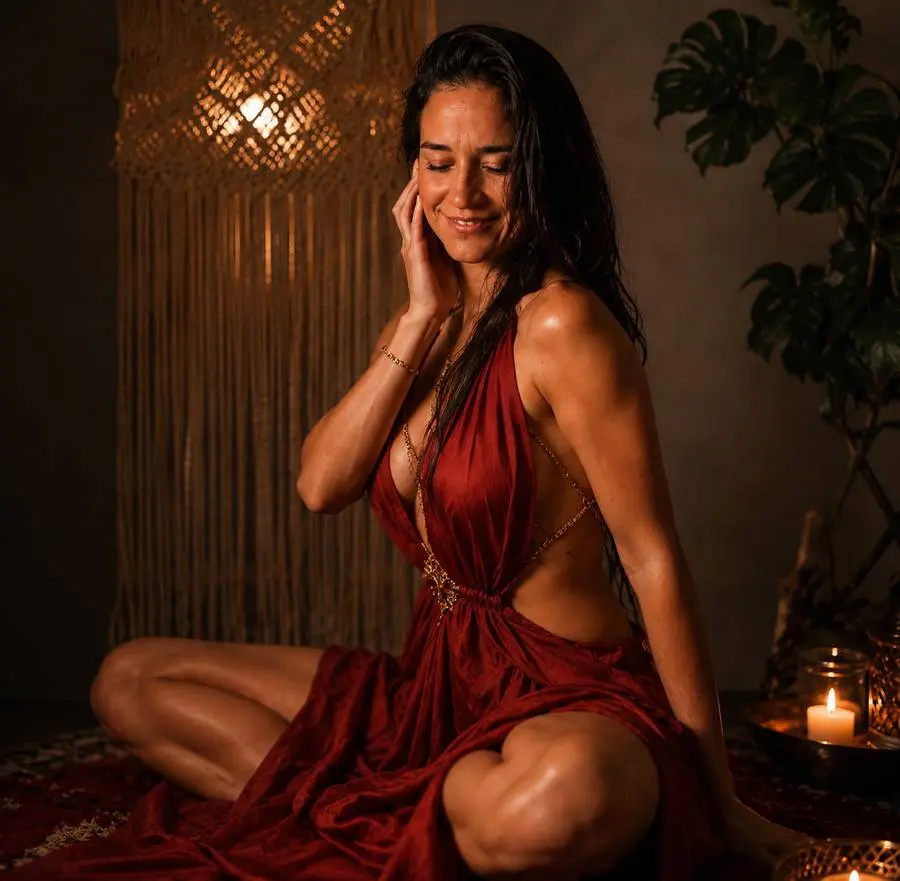
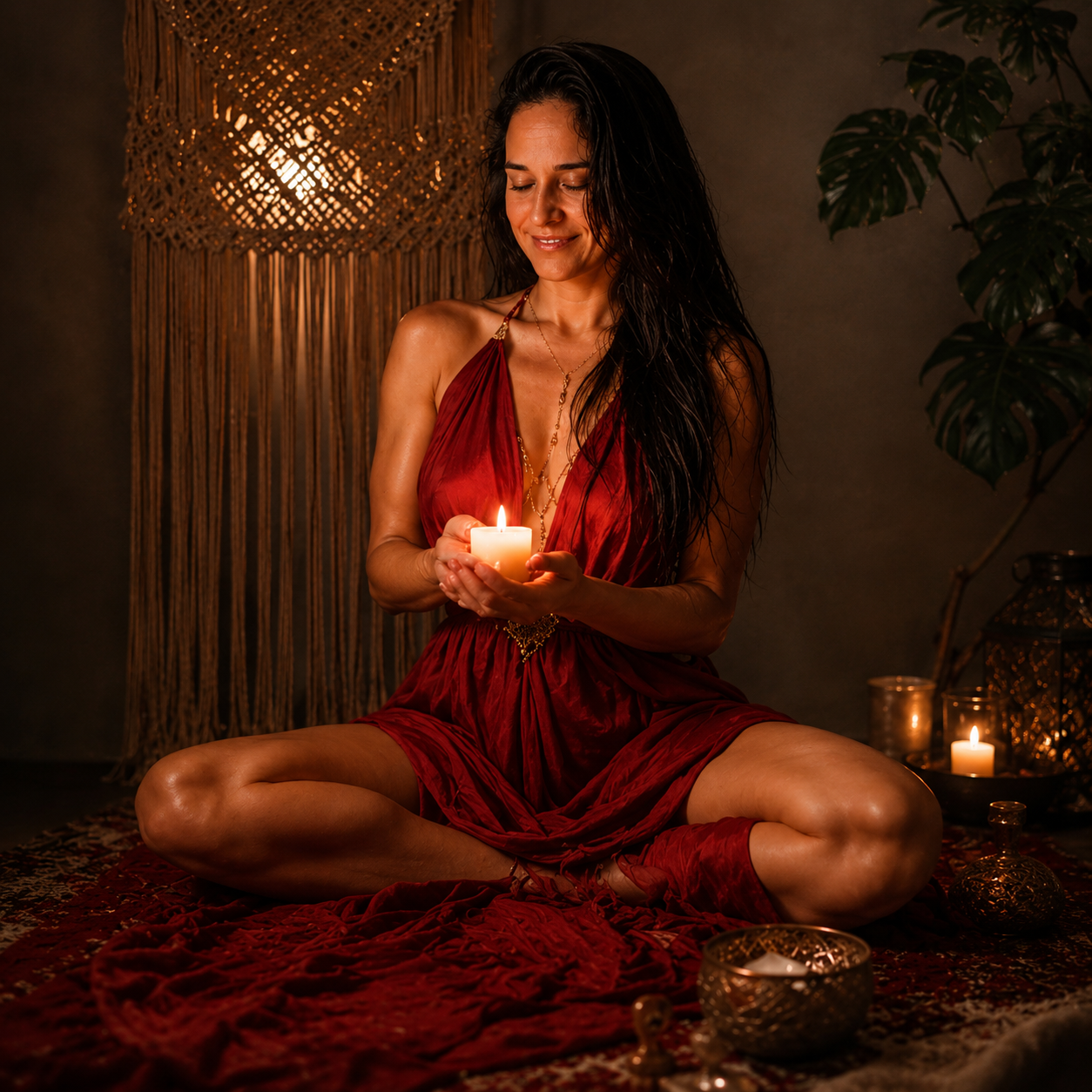
Hi, I'm May Gonzalez.
I’m a Sacred Sexuality Educator, Somatic Sexologist and Tantra Teacher, exploring the meeting point between body, sexuality, energy and consciousness. My work brings together embodied practices, Tantra and sexual wellbeing to support a deeper relationship with pleasure, intimacy and the body.
More About Me →Instagram Journey
Ritual, embodiment, sacred sexuality and glimpses from my work and journey.