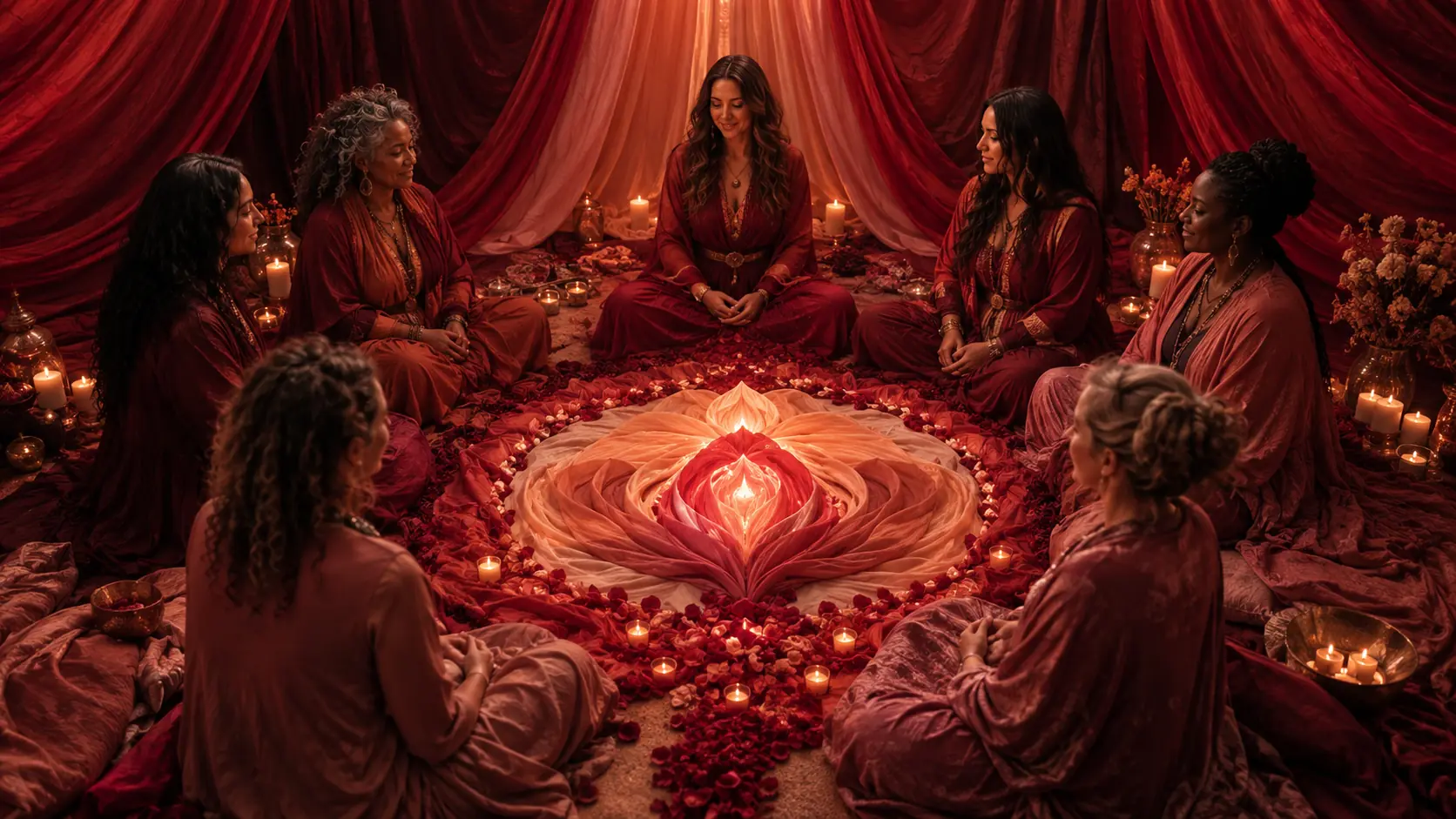

The Sacred Feminine is often associated exclusively with women, yet within many philosophical and spiritual traditions it represents something far more universal. Rather than describing gender, it refers to a fundamental principle of life—one that expresses itself through creativity, receptivity, embodiment and the continuous movement of existence.In Classical Tantra, this principle is known as Shakti, …
The Sacred Feminine is often associated exclusively with women, yet within many philosophical and spiritual traditions it represents something far more universal. Rather than describing gender, it refers to a fundamental principle of life—one that expresses itself through creativity, receptivity, embodiment and the continuous movement of existence.
In Classical Tantra, this principle is known as Shakti, the dynamic power through which consciousness becomes experience. Shakti is not simply a goddess to be worshipped, but a profound philosophical concept that describes the living, creative and transformative nature of reality itself. It is through Shakti that consciousness moves, perceives, creates and expresses itself in the world.
Throughout this article, we will explore the meaning of the Sacred Feminine, its relationship with Shakti and Classical Tantra, and how this ancient understanding continues to offer valuable insights into embodiment, cyclical wisdom and our relationship with life itself.
What Is the Sacred Feminine?
The expression Sacred Feminine is often misunderstood. In contemporary culture, it is frequently associated with women, femininity or certain personality traits such as softness, intuition or nurturing. While these qualities may be connected to feminine experience, they do not fully capture what the Sacred Feminine represents within the philosophical vision of Classical Tantra.
To understand this distinction, it is helpful to recognise that the word feminine can be understood in different ways. At one level, it refers to biological sex and the physical characteristics of the female body. At another, it describes psychological qualities that cultures have traditionally associated with femininity. Neither of these, however, fully explains what the Sacred Feminine means in Tantra.
Within the Tantric tradition, the Sacred Feminine is understood as a universal principle rather than a gender. It is known as Shakti—the dynamic, creative and ever-changing aspect of reality through which life continuously expresses itself. Shakti is the force of movement, transformation and manifestation. Wherever there is life, creativity or change, Tantra recognises the presence of Shakti.
For this reason, the Sacred Feminine is not something that belongs only to women, nor is it a role that someone must perform. It is a dimension of existence present within every human being and throughout nature itself. Understanding the Sacred Feminine therefore is not about becoming more feminine in a social or cultural sense, but about recognising and cultivating a deeper relationship with the living, creative and embodied nature of life.
Shakti in Classical Tantra
Within the philosophy of Classical Tantra, the Sacred Feminine is expressed through the principle of Shakti. While Shakti is often represented as a goddess in Tantric imagery, its philosophical meaning extends far beyond mythology. Shakti is the dynamic power of consciousness—the creative force through which life continuously unfolds, transforms and expresses itself.
Tantric philosophy describes reality through the inseparable relationship between Shiva and Shakti. Shiva represents pure consciousness: silent, spacious and unchanging. Shakti is the dynamic movement of that consciousness, manifesting as thought, sensation, emotion, nature, creativity and every experience of life. Rather than existing as opposing forces, they are understood as complementary aspects of a single reality.
This relationship reflects one of the central principles of Classical Tantra: non-duality. Consciousness and its creative expression are not separate. Just as light cannot be separated from its radiance, Shiva cannot be separated from Shakti. Awareness and life exist together, each revealing the other.
For this reason, Shakti is not understood simply as feminine energy. It is the living intelligence that animates existence itself. Every breath, every movement, every act of creation and every moment of transformation can be understood as expressions of this dynamic principle. The Sacred Feminine therefore is not limited to women, nor does it describe a personality or social role. It points towards the creative, embodied and ever-changing nature of life itself.
Embodiment and Receptivity
One of the qualities most often associated with the Sacred Feminine is receptivity. Yet this word is frequently misunderstood. Receptivity is not submission, passivity or the absence of action. Rather, it is the capacity to remain open, present and responsive to life without immediately trying to control, resist or change what is being experienced.
Within the Tantric understanding, receptivity begins with the body. Before we can respond consciously to the world around us, we must first learn to listen to ourselves. This means noticing our breath, our sensations, our emotions and the subtle ways the body communicates long before the mind begins to analyse. It is through this embodied awareness that receptivity becomes an active expression of presence rather than a passive state of waiting.
To receive requires sensitivity. It asks us to slow down enough to perceive what is unfolding, to remain present with uncertainty and to recognise that not every moment calls for immediate action. In this sense, receptivity is a form of intelligence. It allows us to respond from awareness instead of reacting from habit, creating space for deeper connection with ourselves, with others and with life itself.
The Sacred Feminine reminds us that genuine strength is not expressed only through doing, but also through the capacity to receive, to listen, to feel and to remain fully present. Receptivity is therefore not the opposite of power—it is one of its most profound expressions.
Cyclical Wisdom
One of the most profound expressions of the Sacred Feminine is its relationship with cycles. Nature does not move in straight lines. It unfolds through rhythms of growth and rest, expansion and contraction, activity and stillness. The changing seasons, the phases of the moon, the rhythm of breathing and the beating of the heart all remind us that life is not static but constantly moving through cycles of transformation.
The human body reflects this same intelligence. Breath alternates between inhalation and exhalation. Wakefulness is followed by sleep. Activity gives way to rest. For women, the menstrual cycle offers another powerful expression of this cyclical nature, revealing that the body is not designed to remain in the same physiological or emotional state every day. Rather than resisting change, the Sacred Feminine invites us to recognise it as an essential characteristic of life itself.
Modern culture often encourages constant productivity, consistency and control, asking us to move as though every day should feel the same. The wisdom of the Sacred Feminine offers a different perspective. It reminds us that periods of stillness are not signs of weakness, and that rest, reflection and renewal are as necessary as action and achievement. Every cycle carries its own purpose, and each phase prepares the ground for what follows.
To live in harmony with this cyclical wisdom is not simply to observe nature, but to recognise that we are part of it. The Sacred Feminine invites us to trust the intelligence of change, to honour the rhythms of the body and to understand that growth rarely follows a straight path. Like nature itself, transformation unfolds through seasons, and each season has its own beauty, meaning and contribution to the whole.
The Feminine Beyond Gender
One of the greatest misunderstandings surrounding the Sacred Feminine is the belief that it belongs exclusively to women. Within the philosophical vision of Classical Tantra, this is not the case. The Sacred Feminine is understood as a universal principle of life, not as a biological sex, a social identity or a set of personality traits.
For this reason, every human being expresses both masculine and feminine dimensions. The feminine is reflected in our capacity to receive, to listen, to feel, to create and to remain deeply connected with the present moment. The masculine is expressed through qualities such as direction, discernment, stability and conscious action. These are not rigid categories or fixed characteristics, but complementary aspects of human experience that can be cultivated by anyone.
Recognising the Sacred Feminine within ourselves is therefore not about becoming more feminine in a cultural sense, nor about rejecting the masculine. It is about restoring balance. When these complementary principles are allowed to work together, we become more capable of responding to life with both presence and purpose, sensitivity and clarity, openness and grounded action.
From this perspective, the Sacred Feminine is not reserved for women, just as the Sacred Masculine is not reserved for men. Both are universal expressions of our shared humanity, inviting each of us to cultivate a more integrated, embodied and conscious way of living.
My Understanding of the Sacred Feminine
My understanding of the Sacred Feminine has been shaped through years of studying Classical Tantra, working with the body and witnessing the many ways people relate to themselves and to one another. Over time, I have come to see that the Sacred Feminine is not an identity to adopt or an ideal to imitate. It is a way of meeting life.
For me, the Sacred Feminine is expressed through presence before action, listening before speaking and awareness before reaction. It is the willingness to receive experience fully before trying to change it. It is the intelligence that reminds us that not everything grows through effort, control or constant movement. Some of life’s deepest transformations emerge through patience, receptivity and the courage to remain present with what is unfolding.
This understanding influences every aspect of my work. Whether I am teaching Classical Tantra, exploring Somatic Sexology or guiding embodied practices, I see the Sacred Feminine not as a concept separate from daily life, but as a way of relating to ourselves with greater sensitivity, integrity and awareness. It is not about becoming someone different. It is about remembering a way of being that has always existed beneath the noise of modern life.
Final Reflections
The Sacred Feminine has inspired countless interpretations throughout history, yet its deepest meaning cannot be reduced to a gender, an archetype or a collection of spiritual practices. Within the philosophical vision of Classical Tantra, it points towards the living principle of Shakti—the dynamic, creative and transformative power through which life continuously expresses itself.
To explore the Sacred Feminine is therefore not to search for an identity, but to cultivate a different relationship with ourselves and with the world. It invites us to honour the wisdom of the body, the intelligence of cycles, the value of receptivity and the understanding that awareness and life are never separate.
Ultimately, the Sacred Feminine is not something we need to become. It is something we learn to recognise. The more deeply we inhabit our bodies, listen with presence and move in harmony with the rhythms of life, the more naturally this timeless wisdom begins to reveal itself—not as an idea, but as a lived experience.
When combined, somatic sexology and Tantra offer a holistic approach to sexual and reproductive health, empowering individuals to reclaim their bodies, heal from trauma, and cultivate a deeper connection to their sexuality and creative life force. This integrative practice can be profoundly transformative, addressing challenges such as sexual dysfunction, low self-esteem, stress, lack of sexual education, or trauma related to childbirth, sexual abuse, or other life experiences. It also provides a nurturing space for relaxation and self-discovery.
Self-knowledge is a continuous journey of understanding and connecting with ourselves. As we explore deeper layers of our being, we unlock new pathways to our source of inspiration and vitality, enriching not only our personal growth but also the way we relate to the world around us.
Hi, I'm May Gonzalez.
I’m a Sacred Sexuality Educator, Somatic Sexologist and Tantra Teacher, exploring the meeting point between body, sexuality, energy and consciousness. My work brings together embodied practices, Tantra and sexual wellbeing to support a deeper relationship with pleasure, intimacy and the body.
More About Me →Instagram Journey
Ritual, embodiment, sacred sexuality and glimpses from my work and journey.